
In spring and early summer it is very likely to find chicks that seem to be abandoned and in need of help.
Be careful though!
Not all babies need our help! Often the parents are somewhere nearby and the best thing to do is put the baby somewhere high up and leave it alone.
To know for sure, we should send a photo to a Wildlife Care Centre and wait for instructions.
In cases where we do need to intervene, the following information is useful.
The right instructions can save lives!
And let’s not forget: the aim should always be to return the wild creature to its natural habitat, to reintegrate it into the wild. If we keep the animal longer than necessary, its reintegration will become impossible and that will probably not end well.
In any case, contacting ANIMA is important.
If we find a chick
Warning: these instructions are only useful until you speak with a Wildlife Care Centre representative.
Instructions for raptor chicks
If the chicks are nocturnal (owls etc.), the possibility of finding their parents should be exhausted. That’s because these are usually not abandoned babies but simply ‘naughty’ ones who leave the nest prematurely. More often than not the parents are somewhere nearby.
If we find such a baby we pick a high enough spot on a building or a tree and place it in a natural or artificial nest (a hole in a tree or wall, a box with a hole or a basket). Then we watch to see if the parents visit the baby at dusk. Most of the time this method works. Of course it requires some time investment.
As a rule, all raptor chicks should only be fed raw chicken and not minced meat or other red meat. After a day or two they need special supplements (calcium etc.) otherwise their skeleton collapses, which is why we always refer them to a Wildlife Care Centre. That’s also the only way to give the birds a chance of reintegration.
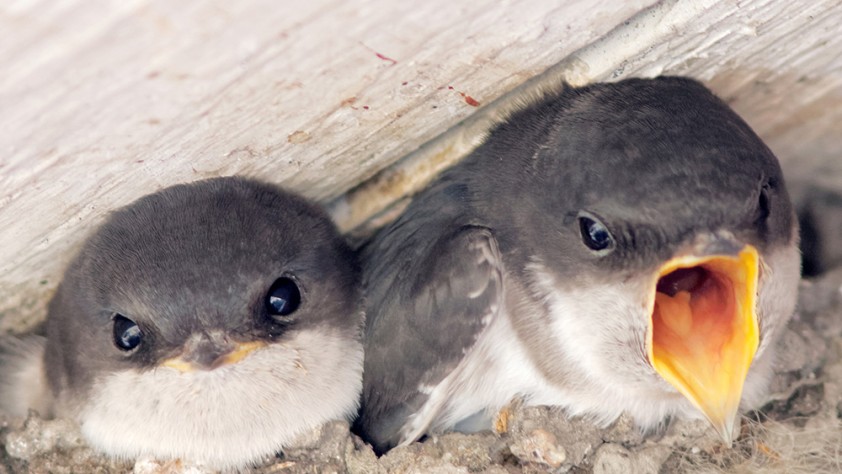
Swallows – Swifts
The right food is frozen insects or mealworms, sold in specialized pet shops and not always easy to come by in provincial towns. However, mealworms alone are not enough.
These birds almost never eat on their own. We have to put the food in their mouth.
A species-appropriate food, until the special food is found or until the chicks are sent to a Wildlife Care Centre, is chicken-based dry food for kittens, soaked in water to become softer. Alternatively, we can sometimes feed them boiled egg white or raw chicken pieces. Swifts are relatively easy to raise and non-experts living far away from Wildlife Care Centres can be relatively successful, provided that they wish to, they keep in touch with experts at all times and they obtain the right food. It is essential that their feathers stay clean and are not damaged, so they must be kept in a cardboard box with lining that is regularly changed (kitchen paper roll, a towel, etc.). When the wings are at least one centimetre longer than the tail while closed, the bird can be released. For the release, pick an open area without power lines and away from highways and give a small push to get the bird to fly into the air. Caution: If we notice that the bird is salivating and its appetite is dropping while rearing it, we must contact ANIMA immediately.
Swallows are more difficult to reintegrate as they are more dependent on their parents than swifts. When they reach an adequate size and are able to fly, they must be released in an area with swallows of the same species during the phase when nestlings have started flying and are being taught to hunt by their parents. This gives them a chance of imitating other individuals of their species. In any case, it is always best to send them to a Wildlife Care Centre.
Sparrows and other seed-eating birds
They must be sent to a Wildlife Care Centre in order to have a chance of reintegrating. Until you are able to send them, they must be fed.
Formulas for seed-eating birds in powder form can be found in large pet shops. You can add water and feed the birds using a syringe. Alternatively you can feed them hard-boiled egg white. When they reach an adult size and shape, release them in an area where many sparrows gather, preferably away from cats.
Blackbird chicks
Until the blackbird is sent to a Wildlife Care Centre, we can feed it insects, dry kitten food, egg and chicken pieces alternately.
Pigeon – Collared dove chicks
They grow up just fine on chick formula mixed with rice flour (without milk). Their crops must be filled with formula 3-4 times a day.
Insectivores (tits, hoopoes etc.)
All insectivorous chicks are generally fed insects and kitten dry food/ boiled egg alternately. You are advised to send these chicks to a Wildlife Care Centre, as reintegrating them is difficult.
Magpie – hooded crow – jay chicks
Must be fed dry kitten food and canned food for kittens/ puppies, raw chicken, egg etc.
Magpie – hooded crow – jay chicks
Must be fed dry kitten food and canned food for kittens/ puppies, raw chicken, egg etc.